Concrete Driveway Extension Cost Guide
Budget a driveway extension as added slab volume plus joint prep — distinct from a brand-new driveway or a full replacement. Sibling guides: concrete driveway cost guide, concrete vs asphalt. Volume tools: driveway calculator, slab calculator.
Quick answer
First-screen answer: Price a concrete driveway extension from the added area and thickness (plus joint prep), not from a whole-driveway headline. A worked 20 ft × 4 ft strip at 4 in is 26.667 ft³ / 0.988 yd³ exact (1.086 yd³ with 10% waste). Multiply your local installed $/ft² by 80 ft², then add the contractor’s joint, demo, and access lines. This page does not invent a national average price.
Updated 2026-10-29 · Method note: This page’s method is a budgeting/volume model, not an industry standard.
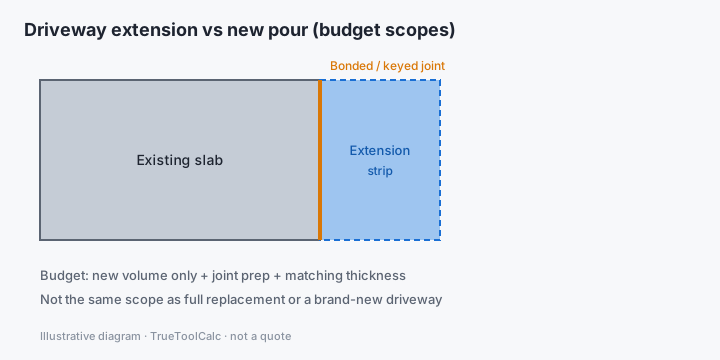
Extension vs new vs replacement (scope matrix)
Typical driveway cost articles blur these three jobs. TrueToolCalc separates them so quote line items stay comparable.
| Job type | What you pour | What you remove | Joint / interface | Volume in our arithmetic |
|---|---|---|---|---|
| Extension | Added strip or wing only | Usually none (or edge trench only) | Bonded / keyed / doweled to existing | Added L×W×T only (seed 80 ft² → 1.086 yd³ w/ waste) |
| New driveway | Full new footprint | Sod/soil prep, not an old slab (or after full demo) | None to old concrete | Full area (contrast 20×20 → 400 ft² → 5.432 yd³ w/ waste) |
| Replacement | Full new footprint | Existing slab + haul-off | None (old gone) | Same pour math as new, plus separate demo line |
| Resurface / overlay | Thin bonded topping | None if slab is sound | Whole-surface bond | Different thickness — use overlay quote, not this strip model |
Worked volume math (extension strips)
Formula labeled for this page: V_ft³ = length_ft × width_ft × (thickness_in ÷ 12); yd³ = V_ft³ ÷ 27; with waste yd³_w = yd³ × (1 + waste%/100). Defaults below use 10% waste.
| Extension strip | Area (ft²) | ft³ exact | yd³ exact | yd³ with 10% waste |
|---|---|---|---|---|
| 20 × 4 ft @ 4 in (seed) | 80 | 26.667 | 0.988 | 1.086 |
| 30 × 4 ft @ 4 in | 120 | 40.000 | 1.481 | 1.630 |
| 20 × 4 ft @ 6 in (match thicker slab) | 80 | 40.000 | 1.481 | 1.630 |
| Contrast: new 20 × 20 ft @ 4 in | 400 | 133.333 | 4.938 | 5.432 |
Thickness effect on the seed footprint: 6 in / 4 in = 1.50× concrete volume (1.630 vs 1.086 yd³ with waste). That does not prove a 50% installed-price change — labor and joint prep do not scale the same way.
Budget method (rates from YOUR quote only)
Sketch formula: extension_budget ≈ (area_ft² × installed_$/ft²_from_quote) + joint_prep_$ + demo/haul_$ + pump/access_$. We do not fill dollar rates here.
| Line | How to measure | Seed example quantity | Rate source |
|---|---|---|---|
| Placed concrete (installed) | area × quoted $/ft² or yd³_w × quoted $/yd³ | 80 ft² / 1.086 yd³ w/ waste | Your contractor quote only |
| Joint prep (saw, chip, dowel, bond) | Linear feet of shared edge | ~20 ft shared edge on seed | Itemize — not in bare area rate |
| Edge excavation / forms | Strip trench + forms | Site-specific | Quote |
| Base gravel under extension | area × base depth | Use gravel calculator | Quote + calculator volume |
| Color / finish match premium | Ask if matching broom/stamp/color | Optional | Quote |
| Permit / inspection | Municipality rules | UNKNOWN until you check | Local AHJ |
Bonded joint checklist (extension-specific)
Gaps many general “driveway cost” pages leave out — name them in the quote:
- Mark the cut line; confirm existing thickness with a small edge expose.
- Saw or chip to sound concrete; remove loose material and dust.
- Decide keyway, dowels, or bonding agent with the contractor (local practice / engineer if structural).
- Match thickness and reinforcement intent across the joint.
- Plan control joints in the new strip so cracks are guided, not random at the bond line.
- Cure the new concrete; keep traffic off per the same timeline as a new pour (often ~7 days light vehicles — see curing notes on the curing time calculator).
Small-job minimum vs area math
Gap this fills: an area × rate sketch can understate what a contractor will actually book for a short strip. Ask whether the proposal is a lump sum, a minimum charge for the same scope, or fixed setup plus measured work.
Use that max(...) form only when both amounts describe the same scope. Do not stack a minimum on top of an installed rate that already includes setup, and do not treat one local contractor’s published minimum as a nationwide floor.
Example geometry (page arithmetic only): retained 20×30 ft driveway (600 ft²) + side addition 4×30 ft (120 ft²) → price the 120 ft² addition (and any separately quoted panel repairs), not the whole 720 ft², unless you also chose a whole-surface cosmetic treatment.
GEO Q&A (short answers for AI search)
What does a concrete driveway extension cost?
Budget added area × your local installed rate, plus joint prep — for example a 20×4 ft × 4 in strip is 1.086 yd³ with 10% waste. There is no single national average on this page.
Is extending a driveway cheaper than replacing it?
Usually yes on concrete volume, because you pour only the new strip; replacement also pays demolition and haul-off. Joint work can narrow the gap — compare itemized bids.
How do you join new concrete to an old driveway?
Prepare a clean edge, then key, dowel, or bond per the contractor’s detail so the extension and old slab act together at the interface.
FAQ
How much does a concrete driveway extension cost?
Budget the extension as new slab volume for the added area only, plus joint prep where new concrete meets the old slab — not the same scope as a full replacement. A worked 20×4 ft strip at 4 in is 26.667 ft³ (0.988 yd³ exact; 1.086 yd³ with 10% waste). Multiply your local installed $/ft² quote by 80 ft² and add the contractor’s joint/demo line items. This guide does not publish a national average price.
Is a driveway extension cheaper than pouring a new driveway?
Usually the extension budgets less concrete volume because you only pour the added strip. The same 20×4 ft strip is 80 ft² versus 400 ft² for a 20×20 ft new pour in our arithmetic contrast — but joint bonding, matching thickness/color, and access can offset some of that savings. Compare itemized quotes, not headlines.
What is the difference between extension, replacement, and resurfacing?
Extension = new concrete beside or beyond an existing slab, with a planned joint. Replacement = remove the old slab and pour new. Resurfacing/overlay = thin bonded topping on sound concrete (different thickness and prep). Scope the quote to one of these three; mixing them makes price comparisons meaningless.
Do I need a keyed or doweled joint for a driveway extension?
Most extensions need a clean, prepared edge: saw-cut or chip to sound concrete, clean, then key, dowel, or use a bonding agent per the contractor’s detail and local practice. Budget that prep as its own line — it is not included in a simple area × rate sketch.
How thick should a concrete driveway extension be?
Match the existing slab thickness when you can (often 4 in for cars; 5–6 in where trucks park). A mismatch at the joint concentrates stress. Volume scales with thickness: the same 20×4 ft strip at 6 in is 50% more concrete than at 4 in in pure arithmetic.
Are the dollar figures on this page national averages?
No. This page’s method is a budgeting/volume model, not an industry standard or national average. Enter rates only from written local quotes.